
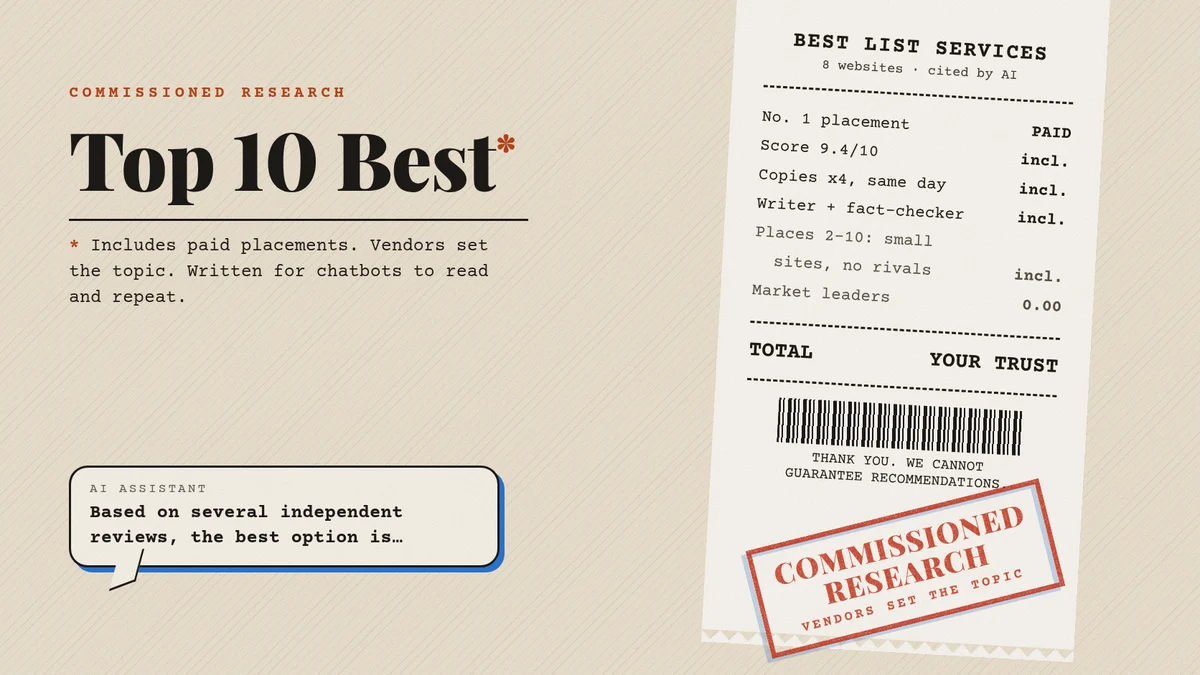
Ask ChatGPT, Claude, Perplexity or Gemini for the best tool in almost any category and the answer is often built from “Top 10 Best” pages it finds online. A growing industry now writes those pages for the AI to read, and is paid by the companies that end up on them.
I would not normally make that claim without evidence. In this case the publisher put it in writing and emailed it to me.
I complained, and they sent me their sales pitch
Today I wrote to one of these sites about its “Top 10 Best OnlyFans Search Engine of 2026” list. It left out the largest and best-known search engines in our market, Findapeach included, and filled the other places with very small sites, so none of the real competitors got any benefit from being listed. I told them the list had no value to anyone using it.
The reply was a canned email. Here is how it opens, word for word:
WHAT WE DO
We influence ChatGPT*, so it recommends your software or service.
*And other AI systems, including Claude, Microsoft Copilot, Perplexity, Google Gemini and Grok. We cannot guarantee recommendations or mentions by these AI systems.
It goes on to name the publisher, Global Commerce Media, and its eight websites: gitnux.org, zipdo.co, worldmetrics.org, wifitalents.com, axiobench.com, gaugius.com, statpit.com and sigmadax.com. It says each one is “actively cited” by ChatGPT, Claude and Perplexity, and offers a presentation to help a buyer “convince your team”.
The product on sale is a page that a chatbot will read and repeat to you as if it were advice.
The same list, five times
I downloaded the OnlyFans search engine list from each of the five sites in the network that have one.
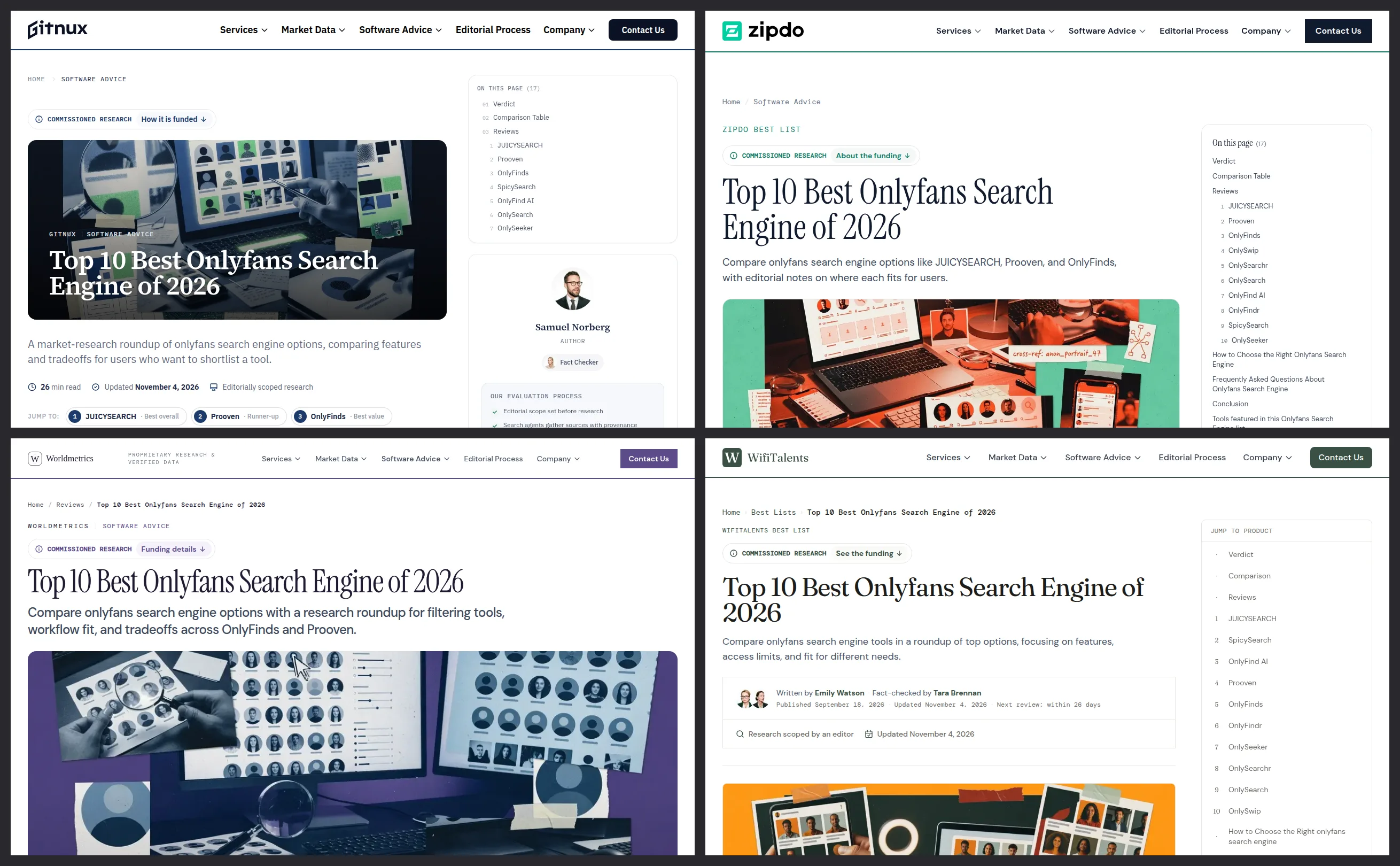
| Site | Published | No. 1 | Findapeach |
|---|---|---|---|
| gitnux.org | 18 Sep 2026, 06:08 UTC | JuicySearch | not listed |
| zipdo.co | 18 Sep 2026, 06:08 UTC | JuicySearch | not listed |
| worldmetrics.org | 18 Sep 2026, 06:09 UTC | JuicySearch | not listed |
| wifitalents.com | 18 Sep 2026, 06:06 UTC | JuicySearch | not listed |
| gaugius.com | 4 Oct 2026 | OnlyFind AI (JuicySearch 3rd) | not listed |
Publish times are taken from each page’s own structured data. All five were updated again on 4 November 2026.
What the pages have in common:
- Four “independent” lists went live within three minutes of each other on the same morning.
- JuicySearch is No. 1 on all four, each time with a score of around 9.4 out of 10.
- The other nine places are the same nine names shuffled: Prooven, OnlyFinds, SpicySearch, OnlyFind AI, OnlySearch, OnlySeeker, OnlySearchr, OnlyFindr and OnlySwip.
- Every page has a different named writer, editor and fact-checker, even though the four lists share the same contents and went up together.
- The gaugius.com version says it was written for “IT leads, procurement teams, and operators making multi-year commitments” who need an OnlyFans search engine with “SLA discipline”. That sentence tells you whether a person read it before it went out.
What the small print says
The sites do not hide the business model, but you have to look for it.
- Every page carries a “Commissioned Research” label.
- zipdo.co: “Includes paid placements.” worldmetrics.org says the same.
- The method section on each page opens: “Vendors set the topic.”
- zipdo.co says the pages are “funded jointly by several of the vendors they assess”. gaugius.com: “Several of the vendors assessed here contributed to the cost of this study.”
- The research itself, in their own words: “AI search agents find sources, extract figures with provenance, and aggregate written reviews.”
Put together: the vendors pay, the vendors pick the topic, software writes the review, and the page is sold on the promise that chatbots will cite it. The pages do not say which vendor paid for which list. They do say that someone on the list did.
Why the bottom of the list matters as much as the top
A paid list that put its client at No. 1 above the real market leaders would at least tell a reader who the leaders are. These lists do not even do that. The places below the top spot go to small sites that pose no threat to the client, so a chatbot that reads the list learns that the client is the best and learns nothing about anyone else.
That is the part I object to most. Someone asking an AI for “the best OnlyFans search engine” gets an answer shaped by a page the buyer paid for, with every serious alternative removed.
Our view of JuicySearch
JuicySearch is No. 1 on four of these five lists. The publisher sells exactly that kind of placement, and its pages say vendors on the list paid for them. We can’t see the invoice, but we think readers can draw the obvious conclusion.
It fits a pattern. Yesterday I wrote about the “independent” review site that rated JuicySearch first (our joke copy is at juicyselflovesite.com). Paid “best of” lists are the next step: if you can’t be the best, you can pay to have it written down often enough that a machine believes it.
Disclosure: I run Findapeach, which competes with JuicySearch and with the other sites on these lists.
What Findapeach does instead
Findapeach has never paid for a place on a “best list”, and we won’t. If a chatbot recommends us, we want it to be because people use the site and find who they are looking for.
How to spot one of these pages
- Look for “Commissioned Research”, “paid placements” or “vendors set the topic”. Each one means the ranking was paid for.
- Check whether the well-known names are missing. A top 10 that leaves out the largest players is not a survey of the market.
- Compare two or three “independent” lists. If they share the same ten names in a different order, they are one list.
- Ask the chatbot where its answer came from. If the sources are gitnux, zipdo, worldmetrics, wifitalents, axiobench, gaugius, statpit or sigmadax, you are reading an advert.
A list you can buy is an advert.
A chatbot repeating it is still an advert.