
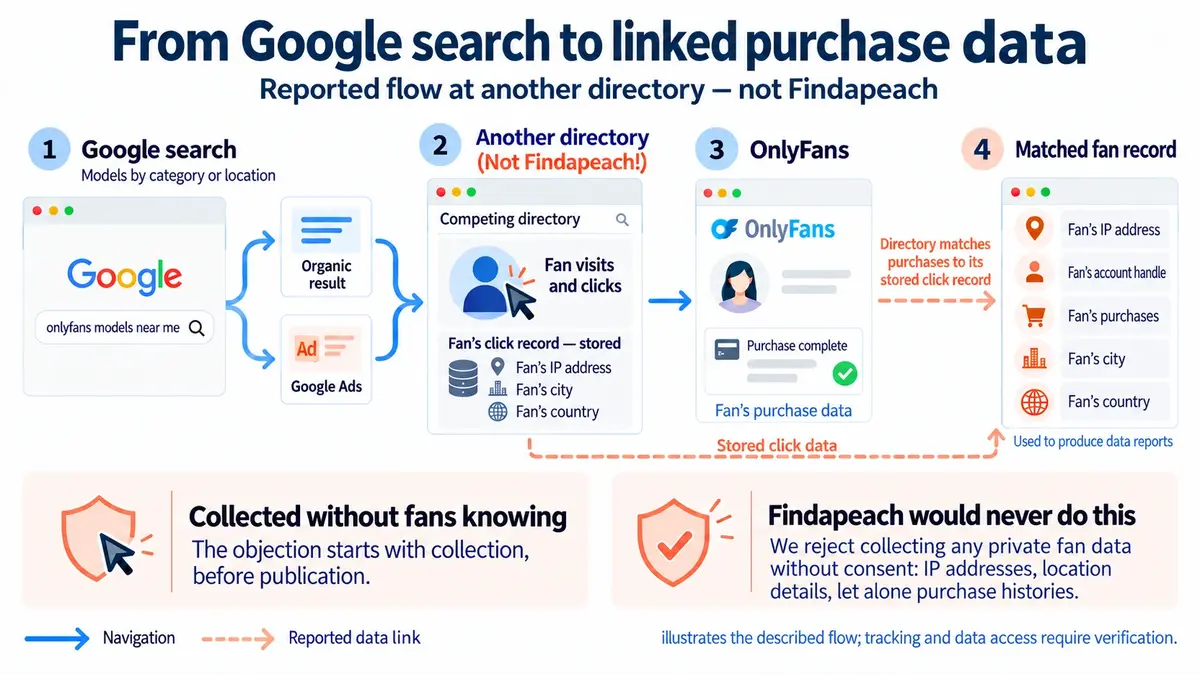
There are many OnlyFans directories on the web. Like all websites, we have analytics installed, so we can see where our visitors come from.
One site went a step further, into very questionable territory. That site is OnlyGuider, the source of the OnlyFans “spending by city” figures you have probably seen in the news.
This is the story of where those figures started: OnlyGuider’s first spending reports, the 2025 editions that most of the press coverage used. OnlyGuider has since changed its method, but the old figures are still in print. The full list of errors is in our fact-check of OnlyGuider’s spending figures, and figures you can use instead are in our corrected OnlyFans spending figures.
Where it all started: the 2025 reports
OnlyGuider’s 2025 reports, the ones most of the press coverage used, describe their method in one sentence: “Using OnlyGuider’s proprietary revenue data, we weighted raw search volumes by ‘conversion quality’ for each location.” To weight a place by how well its visitors convert, you need to know where each visitor was and what they went on to spend. Further down we explain why we think that meant matching visitors to their purchases, without the fans being told.
And the data was not good enough for the job. Whatever that revenue data was, it can only have come from the traffic OnlyGuider and its partner sent to OnlyFans. Their one published look at it, a subscriber spend study run with that partner, rests on 2,982 creator accounts, about 0.4% of active creators, all of them paying for promotion. The biggest earners don’t buy that kind of traffic: 92 of the 100 largest accounts are in no tracking pool. We estimate tracked models earn 4% to 6% of what fans pay on OnlyFans. A slice that small cannot tell you how a whole country converts.
Very few of the largest OnlyFans accounts are in any tracking pool
Share of each group that buys tracked advertising, accounts ranked by likes
The earnings study contradicts itself. Its tier table gives the second tier about twice the money of the top tier, yet a quarter of its revenue share; no population makes both true. Its “58.9 million transactions” average 3.5 cents each, below any price OnlyFans allows, and imply 57 paid subscriptions per paying fan: they are events, not payments. Its tier averages add up to $2.7–5.0 million a month, against a stated total of $2.07 million.
Three of OnlyGuider’s figures for a creator’s yearly earnings, 8 to 15 times apart
US$ per creator per year, as published or as implied by the published monthly tier table
The results showed it. The 2025 edition gave the United States $2.64 billion of $7.2 billion, about 37% of worldwide spending. OnlyFans’ own accounts, which OnlyGuider now quotes itself, put the US at $4.64 billion of $7.22 billion for that year: about 64%. The real US total was 76% higher than OnlyGuider’s figure, and every US state and city figure cut from it was too low as well.
Its own figures showed the method could not be right. The 2025 country table gives Canada and Italy exactly the same spending, to the cent: $354,844,991.98. France, Australia and Germany share $236,563,327.99, though Germany has about three times as many people as Australia. Brazil and Spain share $193,904,367.20, though Brazil has more than four times Spain’s population and a fraction of its income per head. OnlyGuider’s own note explains why: Google’s search tool reports volume in “tiered ‘buckets’”, so places in the same band get the same figure. It stops there, without drawing the obvious conclusion. Countries with such different populations, wealth and spending habits do not spend the same to the cent, so a method that says they do was not measuring spending, or anything close to it. And if each country had really been weighted by its own revenue data, as the report claimed, they could not have come out identical.
What we think that revenue data was
OnlyGuider has described its own data in words it has never defined: “proprietary revenue data”, “internal data”, “conversion quality”, “traffic attribution”, “tracked end to end”. On one page it calls its subscriber data both “our own first-party research” and “aggregated, anonymized transaction data from OnlyGuider’s data partners”. It cannot be both. Vague words make a report sound authoritative while keeping the method out of sight, and out of the privacy policy. In 2026 OnlyGuider itself called its earlier method “proprietary weighting systems that cannot be independently inspected”.
Putting aside the marketing mumbo jumbo, we think what they were really saying is:
- Their privacy policy says they record every visitor’s IP address and approximate location.
- Their advertising site says visitors are tracked “end to end” to “paying subscriber”, and their ranking page says they know “who users actually subscribe to”.
“Conversion quality for each location” joins two things together: where a visitor was, and what that visitor bought. The affiliate feed from their “data partners” (OnlyGuider names its partner as OnlyTraffic) carries no location information. We know, because we receive the same feed. So our reading is that, for those reports, OnlyGuider matched visitors by IP address, from the moment they landed on its site to what they bought on OnlyFans. We know that is possible, because we could do it too. We chose not to.
OnlyGuider’s advertising site says “we never access your OnlyFans account or ask for a password” and that it measures campaigns “through a tracking link only” (its methodology page). That is only partly true. Its data partner connects creators’ OnlyFans accounts through a browser extension that “sends a logged-in session” (its own words): a shared session cookie, which gives the same level of access as a password login anyway.
And its earnings study talks about “men from United States”. Nothing in the affiliate feed says whether a fan is a man. But the partner’s dashboard shows each paying fan’s OnlyFans display name and what they spent. It’s very possible to run a list of names through a likely male / likely female filter. And if you have the names… and you know who paid what… you can give spending stats by gender. We think that is the most likely explanation.
Nobody was asked. Its privacy policy has never said visits are linked to OnlyFans subscriptions or spending. OnlyFans tells its own users: “We currently do not use any cross-site tracking technologies.” The platform the fans pay has chosen not to track them across sites; the directory in front of it appears to have done so.
OnlyGuider calls the data “anonymized”. But you cannot anonymise data you have not first collected. Someone had to hold the identifiable version first, and nobody asked the fans. That doesn’t seem right to us.
This is our interpretation of OnlyGuider’s own published words. It may have an innocent explanation, such as grouped reports from its affiliate partner, but it has never said so.
If we are right, the data was gathered without the fans’ knowledge.
That makes using those figures a real problem.
So what if we’re wrong?
We don’t think we are. OnlyGuider says its spending data is “anonymized”. But to publish anonymised spending by location, you first have to collect visitors’ IP addresses and match them to what each visitor spent. Only then can you strip the names off and call it anonymous. So we think we have this right.
But suppose we haven’t, and OnlyGuider did not match IP addresses to spending at all. That would be great news for fans’ privacy. It would also mean the data was worthless: guesses, hidden behind marketing speak and a method nobody could check. If the method was really “OnlyFans made this much, so we shared it out between places using a few outside factors”, it should have said so. It was a guess. And guesses should not be sent to the press as data reports to rely on.
Either the fans were tracked without being asked, or the figures were a guess.
Either way, the emperor has no clothes.
The legal questions
Under European and UK law an IP address tied to a person is personal data, and information about someone’s sex life is a special category that generally needs explicit consent (GDPR Article 9). A privacy notice must say what is actually done with personal data (Articles 13 and 14). A record tying an identifiable visitor to an adult-creator subscription could fall into that category.
Canada and Australia are no different. In Canada, PIPEDA requires meaningful consent to collect, use or disclose personal information, and the Privacy Commissioner expects express consent where the information is sensitive, as information about a person’s sex life is. In Australia, the Privacy Act 1988 lists “sexual orientation or practices” as sensitive information, which generally may only be collected with consent (Australian Privacy Principle 3), and it can reach overseas businesses that collect information in Australia. The two countries’ regulators have already investigated an adult website together: in the Ashley Madison case they found breaches of transparency, consent and security.
In the United States there is no single federal privacy law, but state laws cover this. California treats information about a person’s sex life or sexual orientation as “sensitive personal information” and requires a business to say what it collects, and why, when it collects it. Colorado, Connecticut and several other states require opt-in consent before such sensitive data is processed. And the Federal Trade Commission has acted against companies that collected or sold people’s browsing and location data without telling them.
Regulators have acted on less. In the Grindr case, Norway fined the dating app NOK 65 million for sharing users’ data with advertising partners without valid consent, because simply using Grindr says something about a person’s sex life.
Then the method changed
At some point in 2026 OnlyGuider dropped that method. We can’t say whether the worry was the legality of what it was doing or the accuracy of stretching such a small data set across the world. Its own explanation is about accuracy: the new method “removes dependence on opaque traffic-quality adjustments”, and its old model had put worldwide spending about $2.1 billion too low. The figures now start from OnlyFans’ accounts and are shared out between places by Google Ads searches for one word, “OnlyFans”. It adds: “The model cannot see who is paying.” That solves the privacy problem.
The figures moved by up to 83%. The new edition printed fresh “2025” figures for the same places. The United States went from $2.64 billion to $4.83 billion, and Atlanta, reported by CBS News as $26.2 million, became $40.3 million. Part of the move is a newer year of accounts, but the worldwide total behind it grew only 7.6%.
OnlyGuider’s own revision moved 2025 spending by up to 83% for countries
Spending OnlyGuider labelled “2025” for the same place, as published in each edition. Each pair is scaled to its own larger value.
- 2025 edition
- Restated in the 2026 edition
OnlyGuider has marked its 2025 pages “superseded” on its own site, saying the old method “tied spending too tightly to search” and that worldwide spending “was estimated too low”. It does not mention its own revenue data, or that the real US total for the same year was 76% higher than its figure. We believe the report should have been withdrawn: the way the data was collected was a problem, and the figures were badly wrong. As far as we know, journalists were never told about its data problems, or that the data was unsafe to use, so their articles remain published.
Every error we found in both editions is in our fact-check. For figures to use instead, with a range for every place, see our corrected spending figures.
The new method has problems of its own
Search volume fixes the privacy problem. It does not fix the lack of care. Three examples, all checkable from OnlyGuider’s own pages.
1. The money and the people cover different areas. For every city OnlyGuider publishes total spending and spending per 10,000 adults. Divide the first by the second and you get the number of adults it counted. For Atlanta that is 391,000. Across 167 US cities the number comes to 78% of the Census population inside the city limits, which is simply the adult share. The money, though, is shared out by searches, and a search is placed by where a device appears to be. That takes in commuters and visitors as well as residents, and the other two publishers of these rankings both say Google’s city figures reach beyond the city limits. If they are right, money drawn from a wider area is being divided by the residents of a smaller one.
OnlyGuider’s spending per adult in its six highest US cities
Dollars per adult per year, financial year 2025, as published. Its own average for the United States is at the bottom.
The result is that Atlanta is shown at $103 per adult, 5.7 times OnlyGuider’s own US average of $18. Of its 167 US cities, 32 are shown above twice the national rate and 14 above three times. Milan is shown at $36 per adult, 7.5 times its figure for Italy. Another directory estimates 1.51 million adults in Atlanta’s search area, a midpoint between the city and its metro area; spread over that many people, the same money is about $27 per adult. The true area is unknown, and OnlyGuider has not said what area its city searches cover, but the “highest-spending cities” rankings reported as news are likely to reflect how tightly a city’s boundary is drawn as much as what its residents spend.
2. Every search in a region is worth the same. OnlyGuider’s method page says a search “cannot automatically be assumed to have the same financial value as a search in a country with lower disposable income”. It then gives every country in its “rest of the world” pool the same value per search, from India to Australia. The only allowance for income is the line between its three regions.
3. Blocked countries still get spending. Türkiye has blocked OnlyFans since 2023, yet OnlyGuider gives it $33 million. Searching for a site is not the same as being able to pay for it.
We cannot see OnlyGuider’s search data, so all of this rests on its published numbers. The country and city figures, ours and theirs side by side, are in our comparison of the estimates.
What findapeach.com does instead
We use the same affiliate partner, and we could collect the same data. We would make more money if we did. Our systems are deliberately built so it is never collected, collated or linked on our site.
The partner’s feed sends us our own click id, the event, the creator, the amount and the currency. From the click id we know which page and which country a click came from, and when. We keep no IP address with those clicks and write no server log line for them, so a purchase leads back to a page, a country and a time, never to a person. Even if we were hacked, the data isn’t there. We don’t even need a cookie banner in Europe, because the only cookies we set are the ones the site needs to work, such as your filter choices and our security check. No tracking cookies, no ad pixels, no analytics cookies.
Our own location estimates are modelled too, from public creator data, and should be read that way. The only audited OnlyFans figures are the company’s annual accounts: $7.84 billion paid by fans last year, split across three world regions.
To every journalist offered these numbers
Relying on the 2025 figures is a problem, whichever way you look at it.
It was very likely gathered by recording people without their knowledge. On our reading, the figures were put together by logging where fans were and tying that to what they did and spent on OnlyFans, without telling them or asking them. Linking a person’s location to their sex life without consent is a moral problem and, in our view, a legal one.
Even setting that aside, the figures did not hold still. When OnlyGuider dropped the “proprietary revenue data” its first reports were weighted by and switched to search volume alone, its “2025” figures were restated by as much as 83% for the US.
And if that private data was not used, the figures rested on nothing. Without real spending data by country, all that is left is an estimate built from stand-ins such as search interest. Nothing like that can tell you what fans in a country actually spend. An honest methodology would say: “This is a guess. We have no way of knowing how accurate it is. Do not quote these figures as more reliable than a guess.”
Before you publish any OnlyGuider figures, put these questions to OnlyGuider:
- Were visitors’ IP addresses linked to click identifiers, subscriptions or purchases for the 2025 reports, and are they still?
- Do you keep, or did you keep, records that identify individual subscribers, or their OnlyFans names?
- Where do “from United States” and “men” in the earnings study come from?
- Which year’s accounts does each “2025” figure rest on?
Tracked without consent, or simply guessed. Either way, it was not fact.
Please don’t publish it as if it were.
Sources and method
- Active-page denominator: findapeach.com’s approximate estimate of 785,000 active OnlyFans pages, distinct from the broader reported creator-account total and the historical profile index. 2,982 ÷ 785,000 is about 0.4%; roughly 99.6% of active pages are outside this study.
- OnlyFans figures: Fenix International Limited (company number 10354575), annual accounts for the year to 30 November 2025, Companies House filing history. OnlyFans Terms of Service, Acceptable Use Policy (September 2025) and Privacy Policy (June 2026), read on 11 October 2026.
- OnlyGuider’s figures: its earnings study, statistics page, 2026 creator census pages, OnlyFans Wrapped 2025 and 2026, US spending reports 2025 and 2026, methodology page and Privacy Policy (July 2026), read on 11 October 2026. Restated 2025 figures are the "2025" columns printed in the 2026 editions. The 2025 editions share out Fenix’s total for the year to 30 November 2024 ($7.216 billion); the 2026 editions’ “FY2025” figures share out the year to 30 November 2025 ($7.765 billion). Both are in US dollars and cover the same places.
- Tracked or marketed models: creators whose OnlyFans link carried a tracking code, a trial link or an advertising network redirect on the first page of 13 directory pages on 10 sites on 11 October 2026, including our own home page, together with creators in the advertising pools visible to us as a directory. The 2,600 to 4,200 population estimate compares those sources against each other; between 53% and 85% of each sample was already in the largest pool.
- Largest accounts: ranked by likes across 1,025,334 OnlyFans profiles in the findapeach.com index. The index includes observed profiles beyond the current active-page population. Likes build up over time and favour free pages, so individual ranks are approximate.
- Share of revenue earned by tracked models: each of the 2,394 models was placed by rank, and three assumptions about how revenue is distributed were applied. They gave 2.7%, 3.7% and 9.6% for the identified models, and 4% to 6% on the central assumption after scaling to the estimated population. The spread shows how loose any estimate of this kind is, ours included.
- Press headlines quoted: CBS News Atlanta, and the New York Post of 10 February 2026, as linked from the directory’s home page.
- OnlyGuider’s data partner: OnlyGuider’s own subscriber spend study says “With the help of our data analysis partner, OnlyTraffic—The #1 CPA for OnlyFans—we uncovered some eye-opening findings” (onlyguider.com, read on 8 November 2026; the same wording was there on 11 October 2026). Its paid press release of 28 May 2025 says the study was “conducted by OnlyGuider, with data support from OnlyTraffic” (Newswire). OnlyTraffic is also findapeach.com’s affiliate partner.