
From the Findapeach Editorial Team
Every so often a type of listing turns up that we simply will not carry, and when that happens we think it's better to say so out loud than to quietly bin it and hope nobody notices. This is one of those.
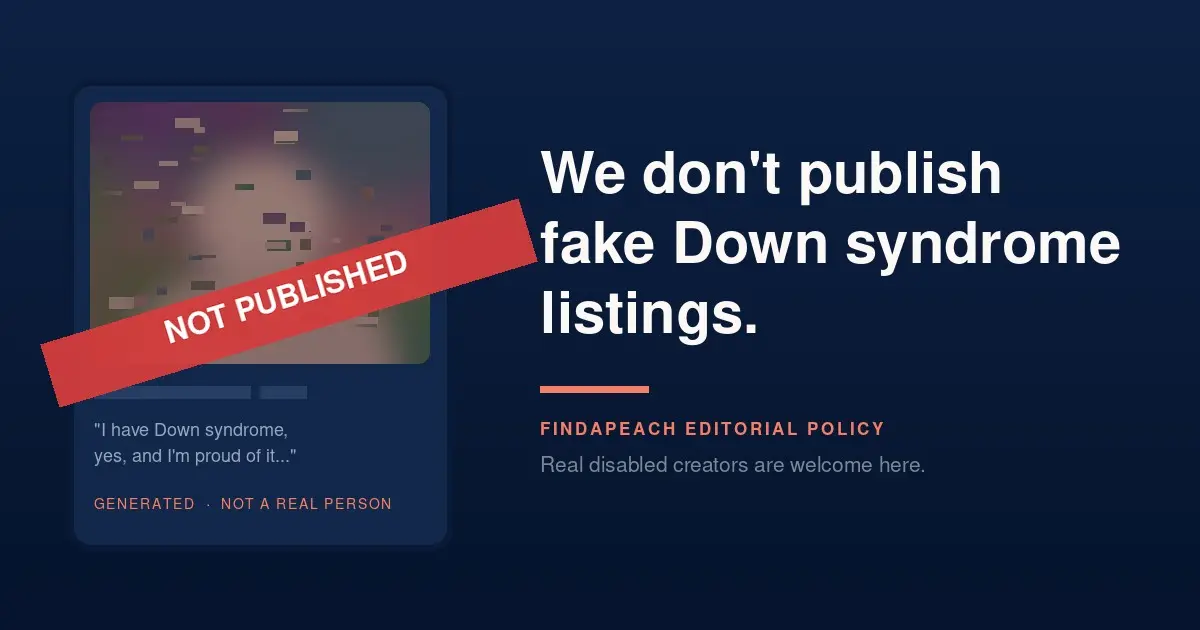
There is a small but growing genre of account that presents a young woman with Down syndrome. She is presented as sweet, friendly and endlessly available, and she will make whatever you ask her to make. The bio says it plainly, usually somewhere near the subscription price: "I have Down syndrome, yes, and I'm proud of it."
We don't publish them at all. They aren't ranked lower or buried on page nine; they are permanently excluded. And when one of them comes back under a new handle, which they reliably do, we suspend that one too.
We think the reasons matter, so we have set them out below.
1. She isn't real
Start with the simplest problem, the one that has nothing to do with disability at all.
The woman in those pictures does not exist. The images are machine-made, and the giveaway is usually right there in the pictures themselves once you look properly: hands that don't resolve, jewellery that changes between shots, a face that is subtly different in every photograph. Nobody is on the other end of the message you send her.
We operate on the assumption that when somebody uses a directory like ours, they are looking for a real connection with a living person. They want to subscribe to someone. Every fabricated profile we let through is a visitor who paid for a person and received a prompt.
That alone would be enough for us to refuse the listing, although it isn't our main reason.
2. It's clearly exploitative
Consider what is actually being sold here.
The product is a sexy, sweet-natured, permanently agreeable, mentally disabled young woman who will produce whatever content you ask her for, and that is the whole of the pitch.
We are not going to host that. It isn't a difficult call and we didn't spend long on it. There is no framing of it that we're comfortable putting in front of our visitors, and no amount of traffic it might bring would change that.
3. We support disabled creators
We want to be very clear about this, because the shortest version of this policy is easy to misread.
There are creators with disabilities on Findapeach. Quite a lot of them. Many do very well here, some of them considerably better than average, because they have built a real audience of people who like them and want to support them. They are welcome, they have always been welcome, and none of what follows is aimed at them.
Our objection is to able-bodied operators who fabricate a disabled woman and sell her as a novelty, which has nothing to do with disabled people making their own adult content.
Two things that can look alike but are very different
Yes · Published
A creator who has a disability
Running her own page, in her own words, on her own terms.
We host many of them. A good number do very well here, often better than average.
No · Not Published
A persona invented by somebody
Who does not have the condition, built to sell it as a fetish.
The woman in the pictures does not exist. Nobody is on the other end of that message.
4. It makes a mockery of the real thing
This is what bothers us most.
Every one of these fake accounts is a person with no disability whatsoever, building an ultra-sexualised disabled character because they've worked out that it converts. They're borrowing the visibility that real disabled creators have had to fight for, and spending it on a gimmick.
It cheapens the work of every creator who is actually navigating this industry with a disability and turns a real condition into a costume. It also teaches visitors to be suspicious of the genuine article, which is a cost paid entirely by the people who least deserve to pay it.
Supporting disabled performers and trading on a fake disabled persona are close to opposites.
What we actually do about it
In practice, the policy runs like this:
- Any listing whose profile presents the creator as having Down syndrome is suspended. We suspend on the claim rather than trying to adjudicate each one, because we cannot verify it from the outside and because this particular genre is now overwhelmingly fabricated. If we get one wrong, we would rather be told and correct it than run the alternative.
- The suspension is permanent, and it survives re-import. Our importer preserves a suspension, so the account does not quietly reappear the next time we refresh our data.
- We track the account, not the handle. These accounts rename constantly, and the new name usually drops the claim from the bio; the same account we suspended last month is back this month calling itself something else and saying nothing about Down syndrome at all. So we keep the underlying account identifier and a copy of the images, and we match on those. Come back under a new name and you get suspended under the new name.
- It applies across every site we run, not just findapeach.com.
If you think we've got it wrong
If you are a real creator, and you genuinely have Down syndrome, and this policy has caught your page, please contact us. We would far rather have that conversation than get it wrong in silence, and we will take a proper look.
For everybody else running these accounts: we can see what you're doing in the data, and your listings will not get through.