
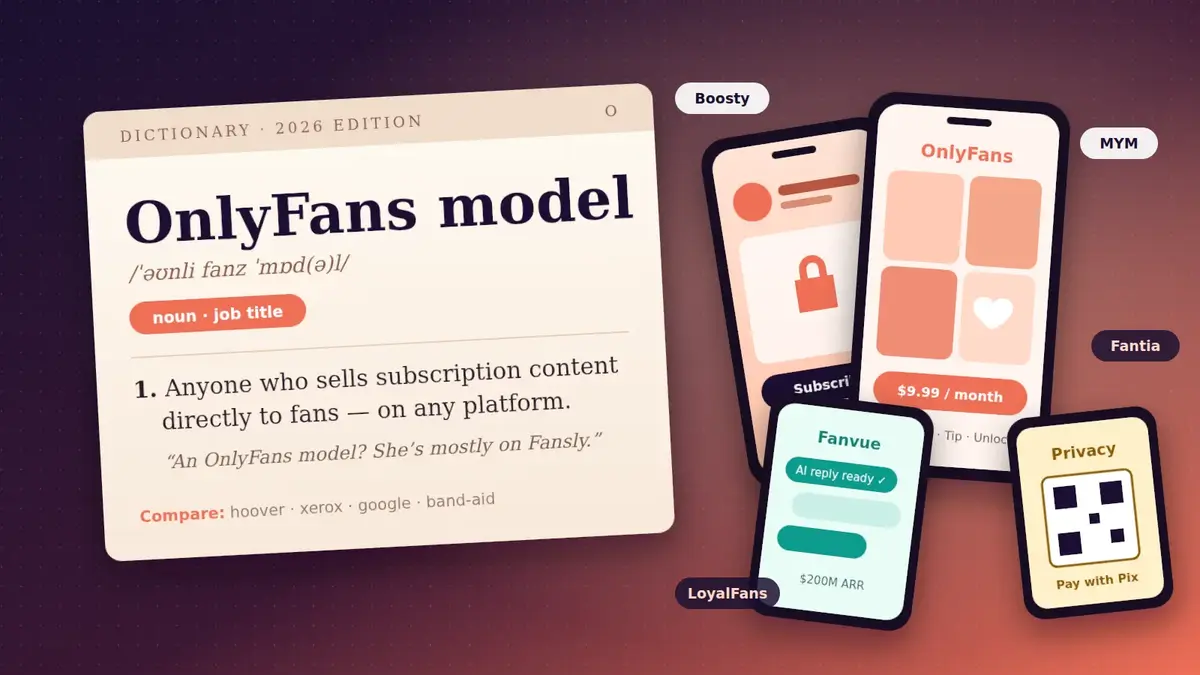
A look at brand genericization in the creator economy, and the dozens of platforms competing for a share of a market one company defines.
At a glance
- “OnlyFans model” is now a generic job title, used for creators on Fansly, MYM, Privacy, Fanvue and more — just as people “google” on Bing.
- The incumbent is huge and lean: $7.22bn in fan payments, ~$709m operating profit, fewer than 60 direct employees.
- Challengers win on features or geography — Fansly on discovery, Fanvue on AI, Privacy, MYM and Boosty on local payments.
- Age-verification laws favour scale, so the market is more likely to consolidate than fragment.
1A word that outgrew its company
Nobody says “I used a search engine to look that up.” They say they googled it, and half the time they googled it on Safari using Bing, or on Brave, or through an AI assistant that never touched Google’s index at all. The verb detached from the company years ago.
The same thing has happened to OnlyFans. “OnlyFans model” has become the default English-language descriptor for anyone who sells subscription-based intimate or personality-driven content directly to an audience. It gets used for performers on Fansly, on MYM, on Privacy, on Fanvue, on LoyalFans. It gets used in job listings for chat operators, in tabloid headlines, in academic papers, in police reports, in agency pitch decks. It is applied to people who have never held an account on the platform in question.
This is the same linguistic drift that turned Hoover into a verb for vacuuming in Britain, Xerox into a verb for photocopying in the US, and Band-Aid, Jacuzzi, Velcro, Escalator and Thermos into common nouns. Trademark lawyers call the endpoint “genericide,” and it is a genuine commercial risk: Escalator, Aspirin, Trampoline and Yo-Yo all lost trademark protection in at least one jurisdiction after their names became the name of the category. Google has spent two decades and considerable legal budget fighting that outcome, and successfully defended its mark in a 2017 US appellate case that hinged on whether a verb’s use kills the brand it came from. It doesn’t, the court decided, so long as the public still knows there’s a company behind it.
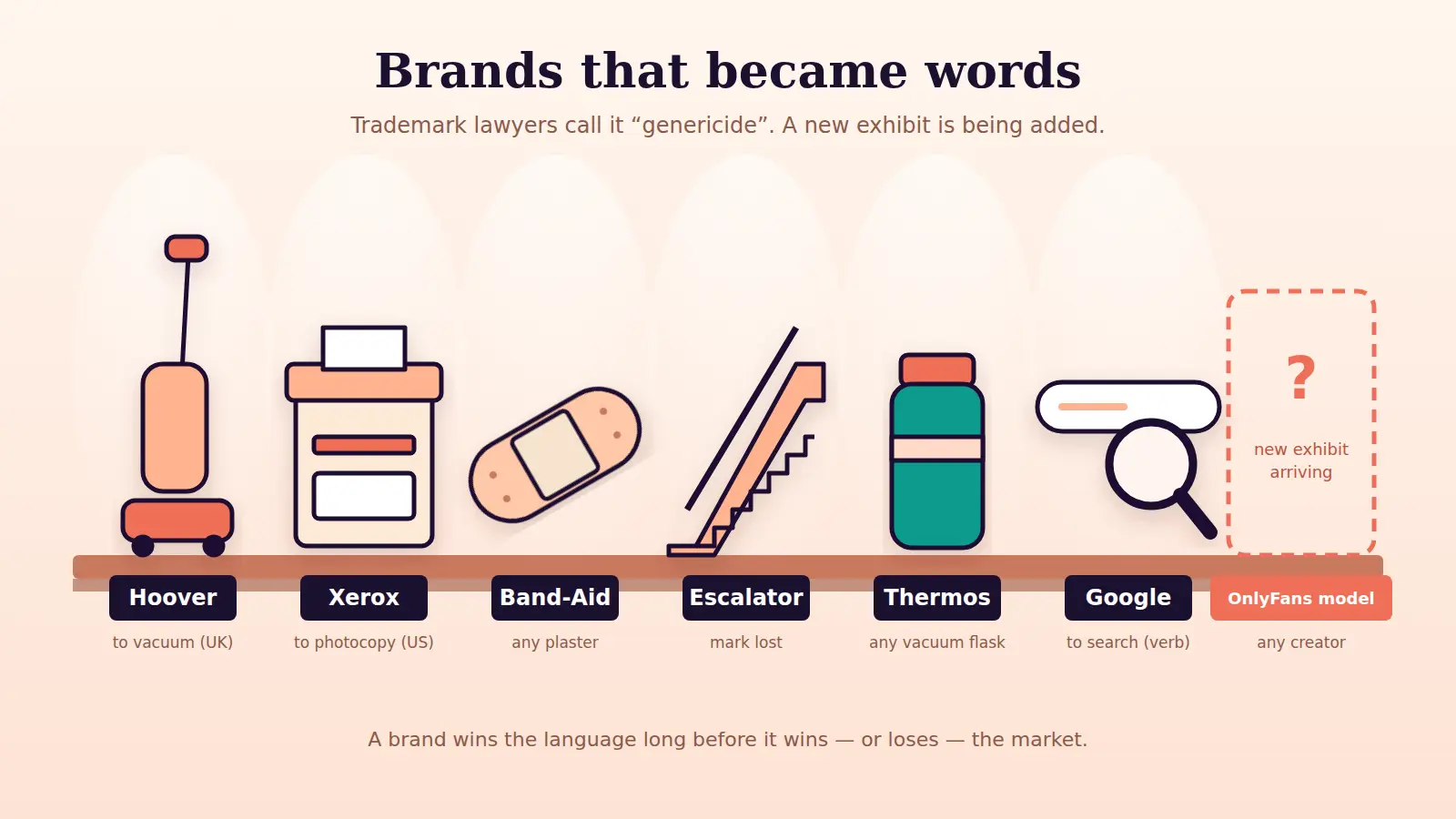
OnlyFans is at an earlier stage of the same journey, and with one important difference. Google spends effort trying to stop genericization. OnlyFans has relatively little incentive to, because in its category the generic name and the market leader are still overwhelmingly the same thing, and free category-defining mindshare is worth more than the abstract legal risk. The brand is the demand-generation engine. Creators put “OF in bio” on Instagram because fans know what it means.
“OnlyFans model” is now a job description in the language, portable across any platform.
But the analogy holds in a more instructive direction too. Google’s dominance of search is real and enormous, and it is also not total, and the places where it isn’t total tell you where the market is actually going.
2The scale of the incumbent
The numbers are unusually well-documented for a private adult-content business, because OnlyFans’ parent, Fenix International Limited, is a UK company and must file audited accounts at Companies House.
That last line is the one that stops economists. A business clearing roughly $700 million in annual operating profit, on a gross transaction volume approaching $8 billion, run by a headcount that would fit in a large restaurant. Most operational load sits with third-party contractors, payment processors and, crucially, the creators themselves, who function as an unpaid sales force, a content studio and a customer support desk all at once.
The corporate story has also moved fast. Leonid Radvinsky, who bought a 75% stake in Fenix in 2018 for a reported $30 million, died of cancer in March 2026 at 43, having extracted roughly $2.5 billion in dividends since 2021. Control passed to his widow, Yekaterina Chudnovsky, as sole trustee of the LR Fenix Trust. Sale talks that had valued the company at around $5.5 billion before his death were followed, weeks later, by the sale of a 16% minority stake to San Francisco’s Architect Capital for $535 million, implying a $3.15 billion valuation. The gap between those two numbers is the market pricing in everything discussed below.
Where the money comes from geographically
Traffic and spend do not line up neatly. The United States accounts for roughly 41% of global traffic and an estimated $2.6 billion in annual fan spend. The UK is a distant second by spend at around $530 million, with Canada and Italy in the $350 million range. Germany has climbed to second by traffic share at around 5.7%, ahead of the UK and Canada. Italy and Spain were the fastest-growing markets in 2025, both up roughly 25% year on year. Around 84% of traffic is mobile.
That geographic concentration matters enormously for the competitive picture. Buying pressure is US-led. A creator whose audience is French, Brazilian or Japanese is fishing in a very different pond, and that is precisely the gap regional platforms exploit.
3The direct challengers
Fansly 20% commissionIn-platform discovery
The closest structural competitor and the one that took the most ground. Fansly’s growth inflection came in August 2021, when OnlyFans announced it would ban sexually explicit content, reversed the decision within six days under creator and press pressure, and permanently damaged its own reputation for reliability. Fansly’s implicit pitch ever since has been “we are the platform that will not do that to you.”
Its differentiation is real rather than cosmetic:
- Tiered subscriptions. Multiple access levels per creator rather than one price point, which raises average revenue per fan through segmentation.
- In-platform discovery. Fansly runs recommendation feeds. OnlyFans deliberately does not, and growth there depends almost entirely on external traffic from X, Reddit, TikTok and Instagram. For a new or mid-tier creator, this is the single biggest functional difference between the two.
- Faster payouts with lower minimums.
- Built-in watermarking and anti-piracy tooling.
The commission is the same 20%. Estimates put Fansly at somewhere around 12 million monthly active users against OnlyFans’ figure roughly an order of magnitude higher, with a user base heavily concentrated in North America and Europe and thin traction in Asia and Latin America. Independent verification of these numbers is difficult; treat them as directional.
Fanvue 20% commissionAI-first
The most interesting business story among the challengers, and the one that is not really competing on the same axis. London-based, founded in 2020 by a former YouTuber, Fanvue has built its pitch entirely around AI: AI-assisted fan messaging that mimics a creator’s voice, AI analytics, an AI coaching layer, and an explicitly permissive stance toward AI-generated and virtual creators at a time when OnlyFans has tightened its rules on synthetic content and deepfakes.
It raised a $22 million Series A in January 2026 at a reported $100 million annualised run rate, roughly 17 million monthly users and 250,000-plus creators, with the company claiming 93% of creators use at least one of its AI tools. By July 2026 it reported ARR had doubled to around $200 million. It takes 20%, with promotional lower rates for new creators.
Fanvue is a bet that the constraint on creator income is not audience size but the number of hours a human can spend replying to direct messages. If that bet is right, it changes the unit economics of the whole category.
LoyalFans, JustForFans, FanCentro, ManyVids and IsMyGirl
The second tier is best understood as a set of niche specialisations rather than a group of would-be OnlyFans killers.
- JustForFans (JFF)The clear leader in gay and queer male content, a vertical where OnlyFans is present but not culturally dominant. It was built by someone from inside the industry and retains that community credibility.
- ManyVidsA marketplace first and a subscription platform second. Its centre of gravity is clip sales, custom content and fetish niches, with a strong contest and community-promotion culture, plus crypto payment support that matters for creators with banking problems.
- FanCentroSits between adult content and influencer marketing, with shoutout campaigns, cross-promotion tooling and paid access to private social accounts.
- LoyalFansDifferentiates on live streaming and interactive features layered onto a subscription base.
- IsMyGirlIsMyGirl and similar operations run closer to a managed-agency model.
- Clips4Sale & iWantClipsRemain the reference marketplaces for fetish and clip-based commerce, categories where the subscription model fits badly.
The SFW adjacent tier
Patreon, SubscribeStar, Ko-fi and Buy Me a Coffee compete for the same creator, not the same content. Patreon’s commission runs well below 20% on most plans and its monetisation is subscription-driven rather than message-driven, which suits musicians, artists, podcasters and fitness coaches and suits adult creators poorly. Patreon’s adult content rules have tightened repeatedly under payment-processor pressure. For a creator working entirely without explicit material, OnlyFans is the wrong tool.
Substack, Passes, Slushy, Sheer and a rotating cast of newer entrants occupy the margins, generally competing on revenue share (some advertise 90%+, a few advertise 100% and monetise elsewhere) at the cost of having no audience to speak of.
The central trap: low fees mean very little when the platform delivers zero discovery. This is the central trap of the alternatives market and the main reason OnlyFans’ position has held.
4The regional map: where the generic term breaks down
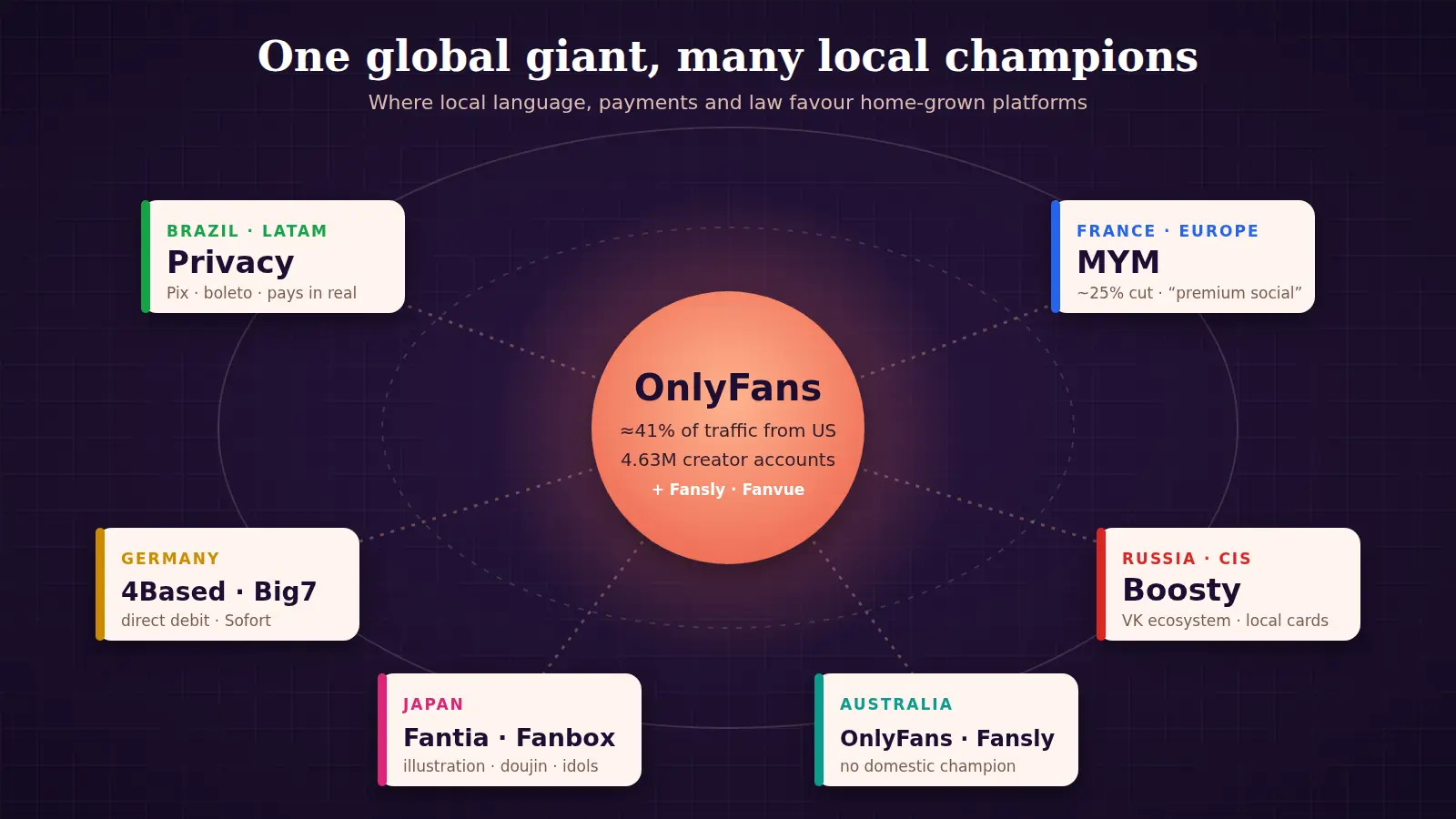
This is where the Google analogy is sharpest. Google holds roughly 89–90% of global search but only around 28% in Russia, where Yandex holds 70%+, and around 2% in China, where Baidu leads. Japan is among the most competitive developed markets, with Google near 72% and Bing and Yahoo together taking roughly 23%. Local champions win where local infrastructure, language, payment rails and regulation favour them.
The adult creator market fragments along the same lines, and for the same reasons.
BRBrazil and Latin America: Privacy
Privacy (privacy.com.br) is the region’s dominant platform and by some distance the strongest non-English-language player in the category. Founded in 2020, it reported over two million users early on and now describes itself as the largest creator platform in Latin America, pulling roughly 17 million monthly visits with traffic overwhelmingly Brazilian.
Its advantage is almost entirely payments. Privacy settles in Brazilian real, supports Pix (Brazil’s instant payment system, near-universally adopted), boleto bancário and local credit cards, and pays creators in real time. An American platform charging in dollars via international card rails faces punishing decline rates and FX friction in Brazil. Privacy charges the same 20% commission but wins on the last mile. It runs through a BVI-registered parent with a Portuguese operating entity, a structure common across the sector.
FRFrance and Western Europe: MYM
MYM (Meet Your Model) is the French-founded platform frequently described as the European OnlyFans. Its commission is higher, around 25%, and it positions itself as “premium social media” rather than an adult site, with a lifestyle and influencer skew alongside explicit content. Distinctive features include blurred rather than blacked-out previews of locked content, “push media” for sending paid content to lapsed subscribers, custom content requests, and a SuperStar visibility programme.
MYM’s case is straightforward: a French or Belgian creator whose audience is European is monetising into a market where OnlyFans’ US-led buying pressure does not apply. It is a strong secondary channel and a weak primary one for anyone with significant US reach.
DEGermany
Germany is the second-largest OnlyFans market by traffic, and it also sustains an unusually developed domestic sector, including 4Based, Big7 and the long-established German amateur-video platforms that predate the entire subscription model. German payment culture (direct debit, Sofort, low credit card penetration) and a distinct regulatory environment have historically protected local operators.
RURussia and the CIS: Boosty
Boosty is the dominant Russian-language creator platform, operated within the VK ecosystem. Its advantages mirror Privacy’s: local payment rails that actually clear, a familiar interface, and an audience already accustomed to supporting creators they know from YouTube and Telegram. International card processing into Russia has been effectively severed since 2022, which makes Western platforms not merely inconvenient but largely unusable. Boosty generates limited organic discovery of its own and functions mainly as a monetisation layer for audiences built elsewhere.
JPJapan and East Asia
Japan supports an entirely parallel ecosystem structured around illustration, doujin and idol culture rather than Western-style performer content. Fantia, Pixiv Fanbox, Ci-en and DLsite serve creators whose output is drawn, animated or otherwise non-photographic, a category Western platforms handle badly and that Japanese obscenity law shapes in specific ways. Fanza dominates commercial adult video distribution. OnlyFans has minimal cultural footprint here despite Japan’s size as a media market.
South Korea’s strict obscenity laws effectively close the market. China’s are absolute.
AUAustralia
Australia is a disproportionately large market relative to population and a significant source of English-language creators, which is why Australian-focused directories and discovery sites exist as an ecosystem layer above the platforms themselves. Australian creators overwhelmingly use OnlyFans and Fansly rather than any domestic platform, monetising primarily into US and UK audiences.
Findapeach does not yet offer every model from every platform. Today our listings are built around OnlyFans creators, so many of the Fansly and other-platform creators described in this article won’t appear here yet.
We are currently trialling multi-platform listings on Aussie Only Models Accounts, our Australian creator directory, and it is very likely to be added to Findapeach as a feature in the coming months.
Australia is also now the most aggressive regulator in the category. It became the first country to impose a minimum social media age, effective December 2025, and its Age-Restricted Material Codes took effect in March 2026. For Australian creators, the compliance environment is tightening faster than almost anywhere.
5What actually differentiates these platforms
Strip away the marketing and the real axes of competition are these.
Revenue share
Almost everyone lands on 20%. Platforms advertising 5–10% or zero are not really in the same business; they are software providers who expect the creator to bring all the traffic. Cam sites run 35–50% for most performers, rising toward 80% at the top, because they supply the audience.
Discovery
The single biggest functional divide. OnlyFans is deliberately a closed storefront with no meaningful internal recommendation. Fansly, Fanvue and most cam sites run algorithmic surfacing. This is why “OnlyFans has 4.6 million creators” is a number that should frighten new entrants rather than attract them: median earnings on the platform are very low, and the distribution is brutally long-tailed.
Direct messaging monetisation
Agencies consistently report that the large majority of creator revenue, often cited above 80%, comes through paid DMs rather than subscriptions. OnlyFans’ messaging and pay-per-view tooling is years ahead of most competitors, and this, more than brand, is the practical reason creators stay.
Payment rails
Underappreciated and decisive. Local payment method support determines whether a market is addressable at all.
Content and AI policy
OnlyFans has moved toward stricter moderation, deepfake bans and mandatory AI tagging. Fanvue has moved the opposite direction. Both are deliberate positioning.
Payout speed and thresholds
Cash flow matters enormously to full-time creators. Daily payouts with a $5 minimum versus a weekly cycle with a $20 floor is a material difference in practice.
6The force that will reshape all of it
Age verification is now the dominant variable in this market, and it is arriving everywhere at once.
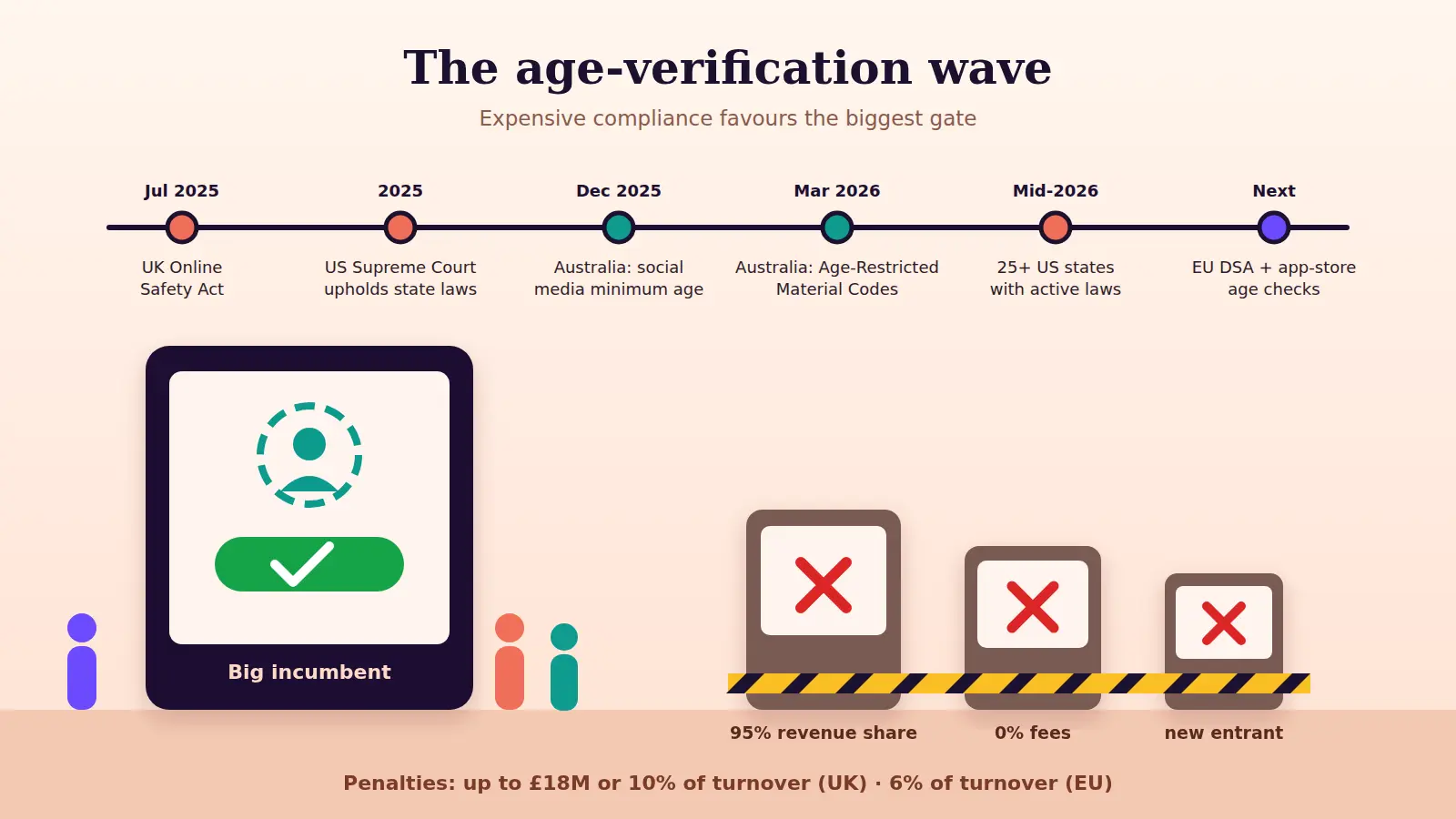
The UK’s Online Safety Act entered enforcement in July 2025, requiring “highly effective” age assurance for any service serving pornographic content to UK users regardless of where it is hosted, with penalties up to £18 million or 10% of global turnover. Ofcom has issued its first financial penalties. The US Supreme Court upheld states’ authority to mandate age verification in 2025, and by mid-2026 more than 25 states had active laws. The EU is integrating age assurance into Digital Services Act obligations alongside the Digital Identity Wallet, with penalties reaching 6% of global turnover. France, Germany and Italy have their own regimes, including ISP-level blocking and payment-processor restrictions.
A second wave is shifting verification from websites to operating systems and app stores. Utah’s App Store Accountability Act and California’s Digital Age Assurance Act move the obligation to Apple and Google rather than individual services.
The effect of all this is counterintuitive. Compliance is expensive, and expensive compliance favours incumbents. A platform with $1.5 billion in revenue can absorb the cost of multi-jurisdiction age assurance. A startup offering a 95% revenue share cannot. Louisiana saw an 80% collapse in Pornhub traffic after its law took effect, though that reflected a decision to block the state entirely rather than verify.
The most likely outcome of the regulatory wave is consolidation, which means the generic term gets more accurate, not less.
7So is OnlyFans really the Google of this category?
Structurally, yes, with caveats worth stating.
✓ Where the analogy holds
- A category-defining brand that became the generic term
- Dominant but not monopolistic share
- Near-total dominance in some national markets and near-absence in others
- Competitors that are genuinely better on specific features and still lose on network effects
- Regulatory pressure that paradoxically entrenches the leader
- A business model where the platform captures enormous value from a marketplace it does not itself produce content for
✗ Where it breaks down
- Google’s moat is technological and capital-intensive. OnlyFans’ moat is almost entirely brand and audience habit, with a product that is, feature for feature, arguably behind Fansly and Fanvue. That is a weaker moat than an index of the web.
- It is also a moat that a single catastrophic policy error can breach, as August 2021 nearly demonstrated.
- Unlike Google, OnlyFans is structurally dependent on payment processors and banks that have shown repeated willingness to withdraw service from the adult sector.
The word will outlive the market position, though. That is the pattern with every generic brand. People still say Hoover in Britain about machines built by Dyson, and Xerox in America about Canon copiers. “OnlyFans model” is now a job description in the language, portable across any platform, and it will still be in use long after the market has rearranged itself underneath it.
Sources and notes
Primary financial data on OnlyFans comes from Fenix International Limited’s audited UK Companies House filings, reported by Variety, Forbes and Bloomberg. Corporate developments including Radvinsky’s death, the Architect Capital transaction and the change of control are from Reuters, Forbes, Variety and TechCrunch reporting in 2026. Search engine market share figures are StatCounter Global Stats, 2026. Fanvue funding and revenue figures are from the company’s January 2026 Series A announcement, Forbes, Dealroom and Sacra. Regulatory detail is drawn from published guidance on the UK Online Safety Act, the EU Digital Services Act, US state legislation and Australia’s Age-Restricted Material Codes.
User, traffic and market-share figures for Fansly, the cam platforms and most regional players are estimates from SimilarWeb, Semrush and industry analysts rather than audited disclosures. Private adult-sector companies rarely publish verified numbers, and figures circulated by agencies and affiliate publishers should be treated as directional. Where a number carries meaningful uncertainty it has been flagged as such in the text.
Platform terms, commission rates and payout policies change frequently. Any creator making a platform decision should verify current published terms directly.